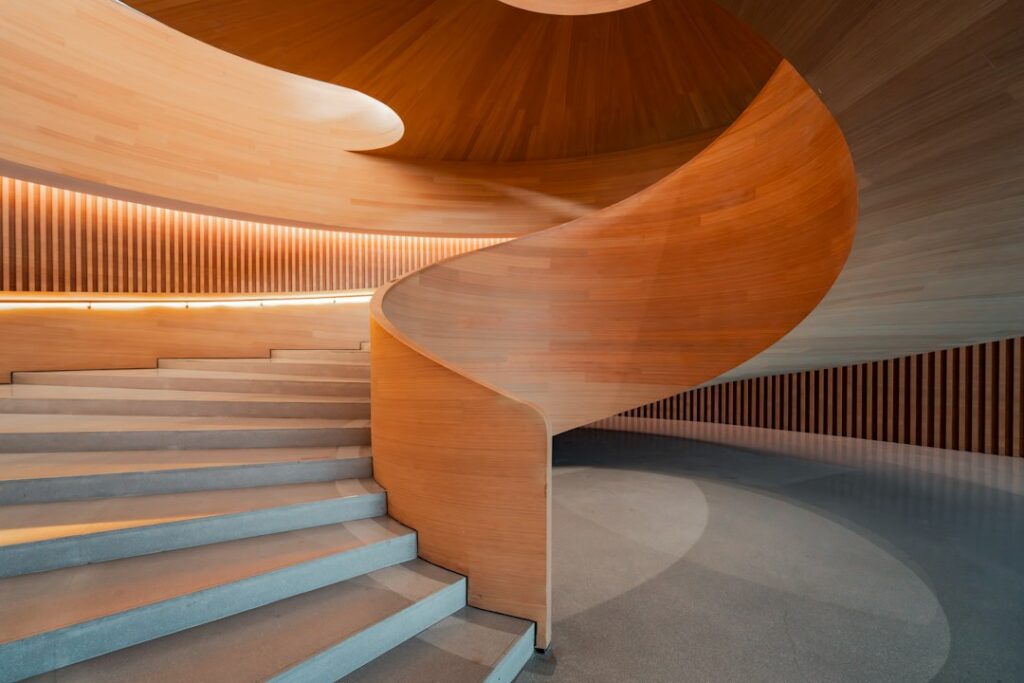

Before choosing a provider, ask for a site survey rather than a price based only on photographs. A survey can record ceiling height, tread width, landing positions and the location of existing wiring. It should also identify practical access for installation and future cleaning. For example, a tall stairwell with a central void may suit a suspended feature, while a narrow staircase may work better with discreet wall or tread lighting. Ask to see drawings, dimensions and a clear description of what is included. A provider who explains these decisions plainly is easier to assess than one who offers only an impressive image.
Think in layers instead of expecting one source to do every job. Ambient light is the general illumination that lets people see the whole stairwell. Task or step lighting adds focused light where feet land, while accent lighting draws attention to a handrail, artwork or architectural detail. These layers can come from a pendant, concealed linear fittings, wall lights or carefully placed downlights. Their combined effect should be balanced, with no sudden leap from a bright landing to a dark flight. A practical example is low-level step illumination paired with softer light above, allowing safe movement without making the space feel clinical.
Beam angle is another useful concept. It describes how widely a lamp spreads light: a narrow beam creates a concentrated pool, while a wide beam covers more area with softer edges. On open stairs, a narrow beam aimed at treads can produce distracting bright spots and deep shadows. On a broad stairwell, an overly wide beam may waste light on walls and ceilings. Glare matters too, particularly where someone looks upwards from the hall. Shielded sources, recessed positions and indirect light can keep the fitting out of the eye while still revealing the staircase clearly.
Colour temperature describes whether white light appears warm or cool, measured in Kelvin. Warm light can complement timber, brass and painted interiors, while a cooler appearance may suit a crisp, contemporary scheme. Consistency matters more than choosing a fashionable number, since noticeably different lamps on adjacent floors can make the space look untidy. Colour rendering, often called CRI, indicates how naturally a source shows colours compared with a reference. A higher-quality source can help wood, stone and artwork look believable. Ask to see samples in the actual stairwell, because wall colour and daylight alter the result.
Controls should be discussed at the design stage, not added as an afterthought. Dimming allows the same installation to feel gentle at night and brighter during cleaning or busy periods. Zoning means dividing fittings into separate groups, such as the lower flight, upper landing and feature pendant. Occupancy sensors can switch lights on when movement is detected, while a manual override gives residents control when needed. Confirm where switches, drivers and access panels will sit. An electrician should also review the proposed wiring and installation conditions, especially in a tall or difficult-to-reach void.
When comparing proposals, judge the whole service rather than the fitting alone. Look for a scaled layout, product specifications, control details, installation responsibilities and a maintenance plan. Ask who will coordinate the electrician, how replacement lamps or drivers can be reached, and whether the finish can be tested before final installation. A good brief might state the desired mood, viewing angles, materials and budget while leaving room for professional recommendations. For wider bespoke lighting design advice, compare completed examples that resemble your staircase. The strongest choice will make the route comfortable, the architecture readable and the system practical to live with.