
Inspect the site in daylight and after dark. Trees, grandstands, boundary fences and advertising structures may block or reflect light, while nearby homes and roads can be affected by spill or glare. Walk the playing area rather than viewing it only from the car park. Note muddy access points, locked gates, drainage channels and the route a maintenance vehicle would take to reach a pole. A court may need a different arrangement from an oval because players look upward more frequently and the playing zone is compact. Early site notes often prevent costly changes to pole positions and cable routes later.
Illuminance, measured in lux, describes the light reaching the grass, synthetic surface or court. The average figure alone does not tell the full story. Uniformity matters because a player moving from the centre into a darker corner may lose sight of the ball even if the overall installation appears bright. Designers assess the distribution across the playing area and review mounting height, aiming angles and fitting locations. A useful habit is to mark the actual playing lines and run-off zones on the plan, rather than treating the entire property as one undifferentiated rectangle.
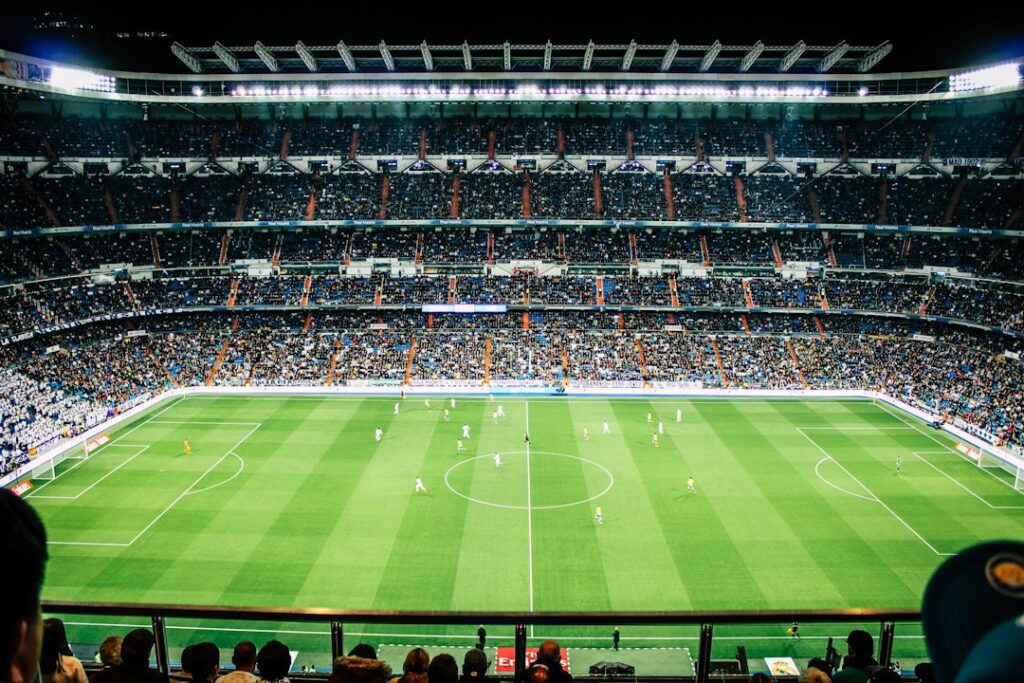
Glare deserves separate attention. A fitting aimed across a player’s line of sight, a spectator’s view or a driver’s approach can make seeing more difficult. Brightness outside the boundary may also disturb neighbours without improving play. Shielding, accurate aiming and suitable beam selection can limit unwanted light, but those measures depend on the pole locations and surrounding buildings. Simply replacing older lamps with brighter LEDs may leave the original aiming problem untouched. During design review, check views from the centre circle, goal areas, benches, grandstand seats and nearby road so the proposal is judged from real positions.
LED fittings are often considered for upgrades because they can direct light accurately and support different output settings. Their performance depends on the whole installation, including optics, heat dissipation, drivers, mounting hardware and electrical protection. Controls should reflect how the venue is actually operated. A club might need a lower setting for training and full output for a match, while a school may prefer clearly labelled switches with fewer operating steps. Before approving a control panel, ask the person opening the venue at six in the evening to demonstrate the intended sequence. If the routine is unclear, it will probably be bypassed.
Electrical work should be assessed as part of the lighting design. Check the incoming supply, switchboard condition, protective devices, underground cable routes, earthing and space for new control equipment. Removing old lamps does not automatically mean the existing infrastructure suits the replacement layout. Load distribution, cable lengths and switching arrangements may change. The project file should also identify any approvals, access conditions or local requirements that apply to the site, with the responsible electrical contractor confirming the details. Photographing the switchboard before work and recording its existing labels can save confusion when circuits are isolated or recommissioned.
Maintenance planning starts before installation. Confirm how fittings, drivers and protective components will be reached, whether an elevated work platform or other lifting equipment is needed, and how a failed unit will affect a scheduled fixture. Keep pole numbers, circuit references, aiming positions and control settings in a handover record. It is worth storing a printed copy in the club office as well as a digital version, because the person reporting a fault may not be the person who approved the project. For practical sports lighting planning advice, the site discussion should cover access, isolation and routine fault reporting, not just illumination levels.
A school extending winter athletics sessions may prioritise simple switching, safe pedestrian routes and limited spill beyond its boundary. A council oval hosting several sports may need separate zones, durable access arrangements and a layout that supports different playing areas. The design brief should state those differences before quotations are compared. For australian sports lighting solutions, ask for the proposed pole locations, lighting calculations, electrical scope, control method and maintenance access to be shown together. Reviewing those documents as one package makes it easier to identify gaps before construction begins.